According to most recent data, more than 70 percent of the population of the Philippines remains unbanked-or those that do not yet have an account with a bank or formal financial institution.
Hot topics:
Real Pinays in Their 30s Share Their Signature Scent
10 Romantic Comedy K-Dramas with a Happy Ending
In the Philippines, banks are classified into three main categories: rural and cooperative banks, thrift or savings banks, and universal or commercial banks.
But how different is one from the other?
To find the answer, we have to turn to the absolute authority on banks and other financial institutions in the country-the Bangko Sentral ng Pilpinas (BSP).
The BSP says the Philippine banking system is composed of universal and commercial banks, thrift banks, rural and cooperative banks.
Universal and commercial banks offer the widest variety of banking services among financial institutions. In addition to the function of an ordinary commercial bank, universal banks are also "authorized to engage in underwriting and other functions of investment houses, and to invest in equities of non-allied undertakings."
They also represent the largest single group, resource-wise, of financial institutions in the country.
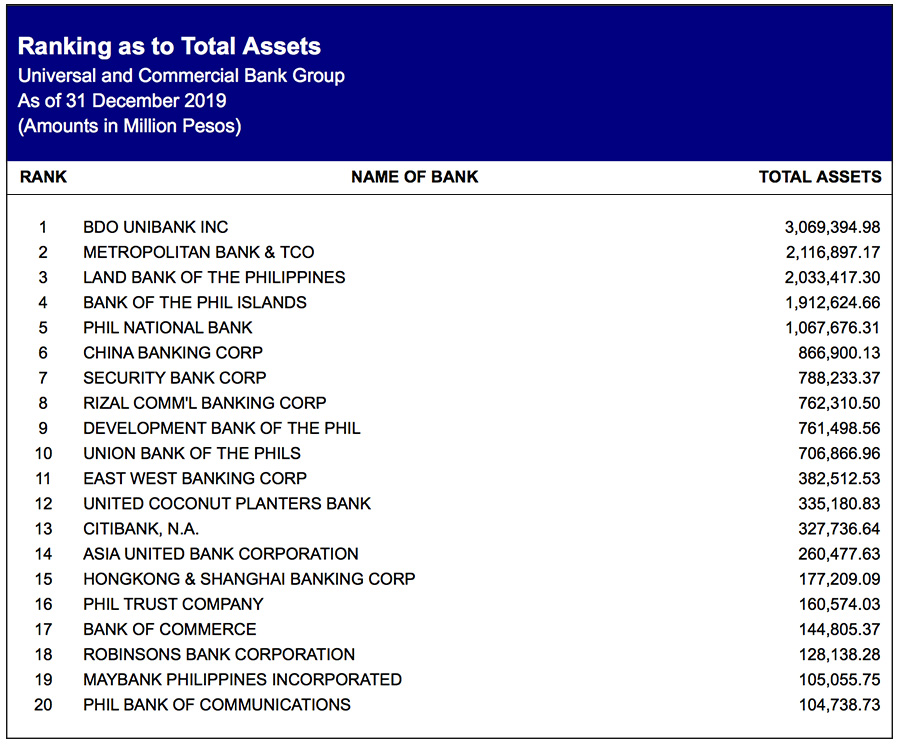
According to the BSP, these are the largest universal and commercail banks in the country by total assets as of December 2019:
Thirft banks, meanwhile, are composed of savings and mortgage banks, private development banks, stock savings and loan associations, and microfinance thrift banks. They are essentially engaged in accumulating savings of depositors and investing them, providing short-term working capital and medium- and long-term financing to businesses engaged in agriculture, services, industry and housing, and diversified financial and allied services, and to their chosen markets, especially small- and medium- enterprises and individuals.
These are the largest banks in the thrift banks group as of December 2019:

Finally, rural and cooperative banks are most familiar to thos eliving in rural or provincial areas. Their role is to "promote and expand the rural economy in an orderly and effective manner" by providing basic financial services. Many rural and cooperative banks help farmers through the stages of production, from buying seedlings to marketing of their produce. These banks are also differentiated from each other by ownership; while rural banks are privately owned and managed, cooperative banks are organized/owned by cooperatives or federation of cooperatives.
These are the largest rural or cooperative banks as of December 2018 (latest available data from the BSP)