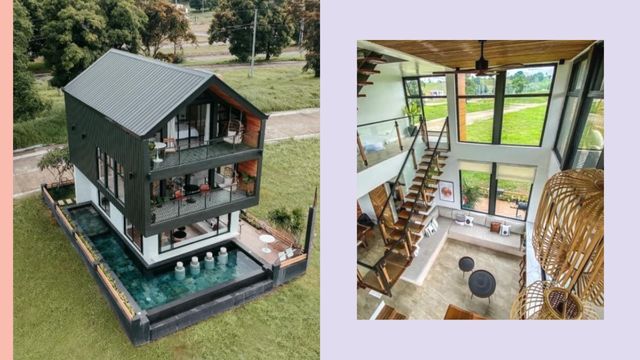
Condo units with small windows, European-style houses with small rooms and thickly carpeted floors—lovely to look at, but have you ever tries staying in them in the 32-degree heat of summer, without air conditioning?
Tropical climates call for tropical homes, but what really comprises a tropical home? “The important principle in building a house or a structure in a tropical setting is that the house must breathe. There should be air movement inside,” explains architect Nick del Castillo of the College of Architecture at the University of the Philippines-Diliman. “Keep heat away from living areas, and let the wind through.”
Before you build or renovate yet another inappropriately stuffy home, keep in mind a few of these principles of designing tropical homes.
1. CROSS-VENTILATION
Cross-ventilation or passive cooling is a basic tropical design principle wherein a structure is cooled naturally without the use of fans or any energy-consuming appliance. This can be achieved with large wall openings (windows and doors), and an open plan layout. A good example of this is the home featured in our previous article.
2. HIGH CEILINGS, WIDE EAVES, SUN SHADES
In an open, sunny field, you will automatically seek the shade of a tree. In the hot and humid climate of the Philippines, do the same with your house—seek shelter from the sun and rain. Del Castillo explains that a roof with a high pitch has more space in between the actual roof and ceiling so that the heat absorbed from the rood won’t go directly into your rooms. “There should be insulation as well,” he adds. Wide roof eaves will prevent sudden gusts of tropical rain from getting inside your home, while awnings, sun screens and trellises keep hot, direct sunlight from hitting your windows.
3. COOL FLOORS
Instead of opting for wall-to-wall carpeting, del Castillo says that (sustainable wood) is a good option for flooring since it doesn’t store heat. Clay and ceramic tiles are also wise choices, as they are cool to the foot, and are quite easy to maintain—a bit of cleaning with soap and water, and it’s OK.
4. USE MATERIALS THAT DON’T STORE HEAT
Are you thinking of using the expected indigenous materials like pawid for your roof, and sawali for your walls? Think twice, as the materials that work in the province will not necessarily work in the city, as there are no code provisions for this in urban areas. Instead of a thatched roof, use your regular GI sheets, only painted white, to deflect heat and not absorb it. Though concrete does not absorb heat, it is still a good-enough material to use in the tropics especially when painted light colors and paired with all the above elements.
(First published in Real Living magazine as “Room to Breathe” in April 2008; photo by Jun Pinzon; adapted for use in Female Network)
ADVERTISEMENT - CONTINUE READING BELOW
Trending on Network