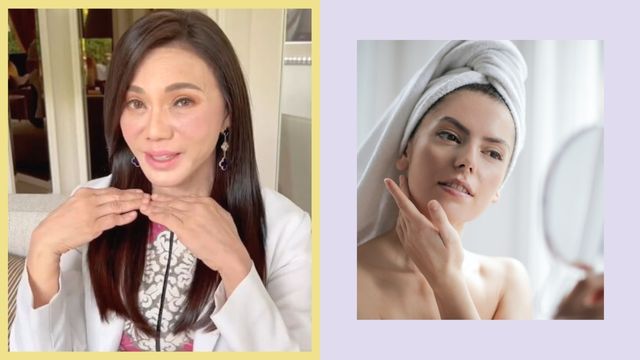
When you’re in your 20s, you feel almost invincible. Sure, there’s still a little bit of acne from your teenage years, but apart from that, your skin is, for the most part, fairly healthy. Fast forward to your 30s and you start noticing a slight difference. Are those fine lines? You cross your fingers and pray to the beauty goddesses that they won’t get any worse. Then you reach your 40s. This is the point where you’ve begrudgingly accepted the fact that aging is a natural process, but you are not so far gone that you don’t notice just how rapid your skin seems to be aging compared with everybody else’s. Is this what they mean by extrinsic aging? It's not your genes that are aging you, but other external factors.
Sound familiar? Regardless of which age group you belong in, it’s important that you take good care of your skin. We talk to Dr. Raissa Francisco-Pasion, a board-certified dermatologist practicing at SKIN Dermatology and Laser Center, about proper skincare for women in their 20s, 30s, and 40s!
It all begins with sunscreen!
“More than 90 percent of extrinsic aging is due to sun damage,” she begins. “In fact, recent recommendations say that sunscreen should be started on kids as young as six months.” That’s because sun damage is cumulative, so the earlier you protect yourself, the less damage control you’ll have to do when intrinsic aging or natural aging enters the picture.
“When choosing a sunscreen, it’s important to choose a broad-spectrum sunscreen,” Dr. Raissa advises. “When we say broad-spectrum, that has UVB, ultraviolet B, and UVA, ultraviolet A protection.” The reason for this seemingly minor detail—UVB bounces off glass, but UVA, the longer wavelength, penetrates it.
“We notice UVB more because it’s what causes burning,” she explains. “UVA causes more wrinkles.”
In your 20s
Now that you have your basic sunscreen regimen down to a T, it’s time to evaluate your skin condition. If your pimples still have a nasty habit of flaring, Dr. Raissa recommends that you look for skincare products with salicylic acid or alpha hydroxyl acids (AHAs) to help control oiliness and acne. “Of course, for more severe acne, they really need the guidance of a dermatologist.”
In your 30s
“In the 30s, that’s when you see cumulative sun damage kind of taking its toll,” says Dr. Raissa. “The cell turnover of your skin isn’t as regular, so usually in their 30s, aside from sunscreen, we advise regular peels.”
Retinoid is also an option. “Retinoid is a group of skincare products that contain vitamin A, which has been shown in studies to: (1) help control acne and (2) do a great job on fine lines and prevention of wrinkles. It also enhances cell turnover and helps stimulate collagen production in the skin.”
Putting on topical antioxidants with vitamins C and E may also keep your skin gorgeous and glowing by helping combat free radicals. Apply it before your sunscreen and you’re good to go.
In your 40s
When you reach your 40s, your skin undergoes a few more visible changes. “We advise women in their 40s to switch to a more emollient moisturizer, but of course, still continuing the topical retinoids they started in their 30s,” says Dr. Raissa.
“Sun spots and pigmentation problems like melasma may also be apparent at this age. Products containing whitening ingredients like hydroquinone, arbutin, or kojic acid may help,” she adds.
(Photo courtesy of Mary Kay)
ADVERTISEMENT - CONTINUE READING BELOW
Trending on Network